Ready for change! The German Flag supports and assists research projects aimed at improving maritime safety, climate protection, and sustainability.
Project ORMOBASS - Navigation without satellite
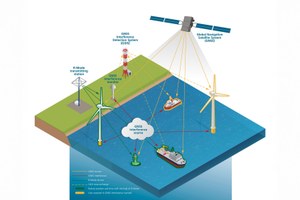
The BSH, GDWS, maritime authorities in the Baltic Sea region, research institutes, and private companies are working closely together under the leadership of the DLR to develop an alternative to satellite navigation. The aim is to make electronic navigation more resilient to interference.
read more
Satellite navigation systems can be severely impaired by interference, whether unintentional or intentional – an issue that has become increasingly important. For this reason, the IMO is striving to make electronic navigation more resilient to interference (IMO e-Navigation Strategy). The R-Mode technology used for this purpose enables the determination of one's own position independently of satellite navigation systems such as GPS, Galileo, or others. Some of the tasks in the ORMOBASS project are:
Ensuring operational R-Mode service in the Baltic Sea and expanding the R-Mode network into the northeastern Baltic Sea as far as Finland
Introducing an R-Mode monitoring system for quality assurance of position determination
Developing new standards
Developing R-Mode navigation receivers for use on board
Here you can find all further information about the ORMOBASS project.
CAPTN - Network for modern mobility
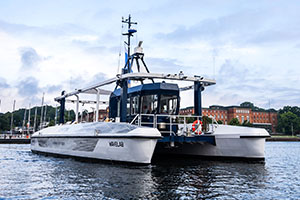
The CAPTN (Clean Autonomous Public Transport Network) is an initiative promoting autonomous and clean modes of transportation on land and water.
read more
Numerous projects have already been launched under the CAPTN network umbrella. Partners from civil society, business, academia, politics, and administration have joined forces to develop, among other things, new mobility concepts and systems for autonomous craft. The goal is to create products and services that are innovative, marketable, system-compatible, and sustainable.
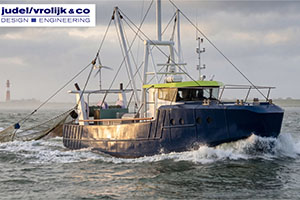
The “ZukunftsKutter Nordsee” (KuNo) will be a climate-neutral, multifunctional fishing vessel flying the German flag. It will be just under 20 meters long and powered by methanol. Construction is scheduled to begin in 2027.
read more
The “ZukunftsKutter Nordsee” (KuNo), a climate-neutral and multifunctional North Sea fishing vessel, will become a reality starting in 2027. That is when construction of a prototype of the new fishing vessel will begin. Sea trials in the North Sea are scheduled to begin in 2029. A similar project is planned for the Baltic Sea. The cutter will sail under the German flag.
This is what the “ZukunftsKutter Nordsee” is expected to look like:
The cutter will be 19.5 meters long, 5.90 meters wide, and have a draught of 2 meters. The fishing boat has been deliberately designed to be large so that fishers can venture further out to sea.
The wheelhouse is located at the bow. Project managers anticipate several advantages from this design: During night operations, glare from the working deck’s lighting will not blind the helmsperson. Weather protection is better on the aft deck. The wheelhouse and technical components are positioned close together.
The accommodation on board is located in the foredeck. The accommodation and fishing operations are separated from one another.
The hold is designed to take around 330 standard fish crates.
The vessel is to be powered by environmentally friendly methanol (hence the long ventilation mast). An electric motor with two large and one small generator (which can be switched on and off) is to be located in a separate room.
The Federal Ministry of Agriculture is providing 10 million euros in funding for the construction of the KuNo prototype. The funds will finance the development, construction, and seatrials of a prototype of the new fishing vessel as well as a methanol refueling station. In addition, environmentally friendly fishing methods and other potential applications beyond shrimp fishing will be tested. The joint project is being carried out by the University of Applied Sciences Emden/Leer in collaboration with the Thünen Institute of Sea Fisheries and the Lower Saxony Wadden Sea National Park Authority.
The German Flag (Ship Safety Division of the BG Verkehr) is assisting and promoting the development and construction of the KuNo prototype. KuNo will make an important contribution to greater ship safety, climate protection, and better working conditions in the German fishing fleet.
TheDEMASK Project – On Underwater radiated Noise
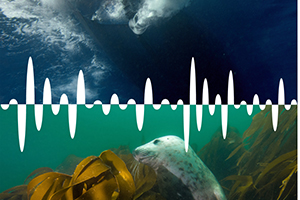
Human activities in the North Sea are leading to an increase in underwater noise—an issue of growing importance for shipping as well. The DEMASK project aims to promote the effective reduction of underwater noise.
read more
The North Sea is one of the busiest shipping areas in the world and is also used for other human activities such as fishing and tourism. Given the ambitious plans for energy generation through offshore wind farms, the North Sea will undergo profound changes in the coming decades that will impact the marine ecosystem; it is therefore crucial to make the use of the North Sea more sustainable.
The EU Interreg North Sea project DEMASK brings together policymakers, administrations, non-governmental organizations, and the maritime industry to develop a joint, sustainable noise management strategy. The project will provide information on the effectiveness of noise reduction measures, thereby enabling science-based decisions.
DEMASK
defines management scenarios in consultation with relevant stakeholder groups,
evaluates these scenarios, including their impacts on marine biodiversity, and
then identifies particularly suitable strategies for noise management.
The BSH is participating in the DEMASK project to further strengthen its expertise in assessing the impacts of underwater radiated noise in the context of maritime spatial planning, the expansion of offshore wind energy, and shipping. It supports and shapes the development of future strategies for measures to mitigate underwater noise in the North Sea. In doing so, the BSH also fulfills its mandate for “noise mapping” and the “establishment and operation of the national sound register.
The issue of underwater noise is also becoming increasingly relevant for shipping. In July 2023, the Marine Environment Protection Committee (MEPC 80) adopted the revised “Guidelines for the Reduction of Underwater Noise (MEPC.1/Circ.833).” Underwater noise is recognized as a pollutant in the Marine Strategy Framework Directive (MSFD), and EU member states are urged to monitor and reduce noise pollution. Underwater noise is a key issue for the Regional Marine Conventions for the North-East Atlantic (OSPAR) and the Baltic Sea (HELCOM). OSPAR and HELCOM work closely together in this area.
Here you can find all further information on the DEMASK project:
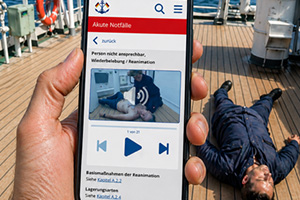
Access to life-saving emergency medical procedures from any smartphone - practical and easy for laypeople to understand, as navigational officers handle medical emergencies on board. As of 1 June 2026, MediSee is the optimal digital companion to the Maritime Medical Handbook.
read more
The app was developed by Annelie Ewen (Maritime Medical Service), Dr. Philipp Langebuch (former head of the Maritime Medical Service), and Dr. Jens Tülsner (Marine Medical Solutions). It is published by the Federal Ministry for Transport, which also provided the funding.
The app is:
bilingual (German/English)
offline-capable
free
quickly updatable
It offers:
Audio guides for acute emergencies and immediate life-saving measures
Direct links to relevant subchapters in the Maritime Medical Handbook
Direct access to forms, such as for “Bodycheck” assessments
Direct access to videos, such as on “Basic resuscitation measures”
Intelligent search function via keyword entry
With the MediSee app, the German Flag has created a smart and pioneering digital solution that can save lives on board seagoing vessels. The app itself provides further information in a very clear and accessible way. It can be downloaded via these QR codes (left: App Store; right: Google Play Store):