

News 2025
The Norwegian Maritime Authority has issued a safety notice regarding an accident involving a line throwing appliance of type JH7-230-91, produced by NINGBO ZHENHUA, in which a person was seriously injured. The device lacked sufficient external labeling with clear safety instructions. This deficiency also affects other devices of the same type.
For your own safety, please take note of the information provided by the Norwegian Authority and check whether you have any JH7-230-91 NINGBO ZHENHUA line-throwing appliances on board.
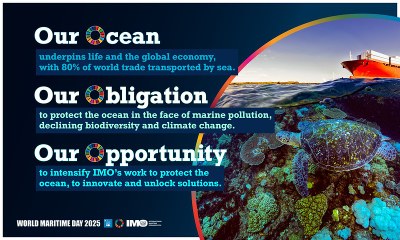
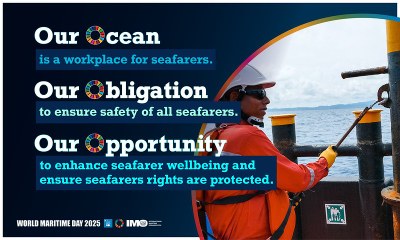
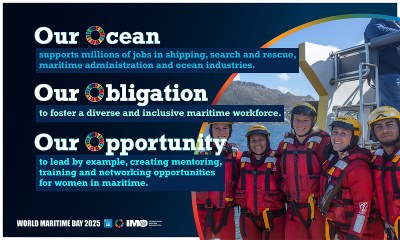
This year, the shipping world celebrates the World Maritime Day on 25 September. The International Maritime Organization (IMO) has declared this year's motto to be: Our Ocean, Our Obligation, Our Opportunity.

On 25 September, the IMO headquarters in London are lit up in blue and, on its social media channels X (former Twitter), Instagram, Facebook and LinkedIN, the IMO and its followers celebrate maritime shipping under the hashtag #WorldMaritimeDay. The UN specialized agency calls on its member states to illuminate their buildings in blue as well or celebrate the World Maritime Day with other campaigns. Germany will hoist the flags at its official buildings in North Germany on the day; for this a special flag order has been issued.
On the IMO website, the Secretary General of the IMO, Arsenio Dominguez, directs a special greeting to the maritime world. In it, he draws our attention to the this year's theme of the World Maritime Day "Our Ocean, Our Obligation, Our Opportunity", which is closely linked with the Sustainable Development Goals of the United Nations. The oceans are essential in many different ways for us humans - as well as for marine animals. Moreover, they regulate the climate of the earth. Because the protection of the oceans concerns us all - big or small - the Secretary General visited a school in England this year where he was interviewed by the some of the pupils about marine environment protection.
Cyber-attacks are a large threat for safe and smooth shipping. Aside from the dangers it poses to the ship, its crew and the environment, the financial damage is oftentimes also significant. The comprehensively revised IMO guidelines provide shipping companies and crews with assistance to harden the ships defences against computer attacks aimed at their digital infrastructure with an effective cyber risk management.
Effective cyber security depends, for one, on the ship's type, trading area and how digital it is as well as the interfaces leading outside. But there are also some fundamental aspects that should be observed – and this is where the IMO guidelines come in and provide valuable advice about how the issue of cyber security on board a ship can be approached and what should be considered in any case. Don't forget: The individual cyber risk management on board has to be specified in the ship's safety management system (SMS).
The IMO has revised their guidelines and published them as circular MSC-FAL.1/Circ.3/Rev.3. The guidelines now define key terms for this increasingly important security issue and focus on which systems need to be considered: from integrated bridge systems over cargo handling and general security systems to administration and crew management software.
For an effective protection against cyber-attacks of any kind, the guidelines identify 6 functional elements that should be part of the cyber risk management of any ship:
- Clearly define who is responsible for the cyber risk management both in the shipping company and on board,
- Identify all digital systems – especially those that could be particularly vulnerable to cyber-attacks,
- Advice about the available options of cyber protection: from password and firewall to incidence response plans,
- Detection of attacks,
- Short- and long-term response and reaction to an attack,
- Transition back to normal operation after an attack.
functional elements. Only if ship management and crew are aware of the threats posed by a cyber-attack and what impact it would have, they will take the necessary (personal) cyber hygiene seriously and, thereby, be able to ward off attacks successfully as well as react correctly in case of an emergency.
The IMO guidelines also contain tips on further references on the topic, which have now been supplemented with requirements (procedures and technical standards) of the International Association of Classification Societies (IACS).
We as German Flag offer additional support for you with our Guidance "Ism Cyber Security" developed together with the Federal Office for Information Security (BSI) that contains practical tips on planning cyber risk management in the safety management system (SMS) in accordance with MSC.428(98).
More information about the topic can be found in the ISM Circulars 04/2017 and 01/2020 as well as here on this website under Cyber Risk Management.
With the latest SOLAS amendments, the IMO prohibits the use or storage of extinguishing media containing perfluorooctane sulfonic acid (PFOS).
The IMO amended the regulations II-2/1 and II-2/10 SOLAS in order to protect the crew against exposure to this dangerous substance used in fire-fighting systems as well as to minimize the impact on the environment. This primarily affects fire-extinguishing foams in stationary and mobile systems and in portable fire extinguishers.
Fire-extinguishing media containing perfluorooctane sulfonic acid (PFOS) shall be removed from the ship and delivered to appropriate shore-based reception facilities.
These changes apply to ships constructed on or after 1 January 2026. All ships constructed before 1 January 2026 shall comply to this requirement not later than the date of the first survey on or after 1 January 2026.
At the same time, there are changes to the 1994/2000 High-Speed Craft Code (HSC), Chapter 7.
With the attached circular MSC.1/Circ.1694 of 4 July 2025, the IMO provides unified interpretations (UI) and thus gives guidance on compliance matters.
Newly built ships may only be equipped with a certified, PFOS-free extinguishing medium. For the extinguishing media used on existing ships, proof that the extinguishing medium is free of PFOS must be provided, for example an approval certificate or a laboratory test – otherwise the extinguishing medium needs to be replaced. In order to avoid PFOS contamination, please note that stationary systems may need to be cleaned when replacing the extinguishing agent.
If you need to dispose of media containing PFOS, please ensure that you obtain suitable documentation and keep complete records, including entries in the ship's logbook. You may need this to prove that you have complied with the disposal requirements.
Additional information:
- Reference IMO resolutions. MSC.532(107) - SOLAS, MSC.536(107) - 1994 HSC Code, MSC.537(107) - 2000 HSC Code.
- First survey: the annual, periodical or renewal survey, whichever is due first (e.g. cargo ship safety equipment certificate, cargo ship safety certificate, passenger ship safety
certificate, or high-speed craft safety certificate). - New or replacement extinguishing media shall be marked as PFOS free. The extinguishing media shall be approved and certified in accordance with the Implementing Regulation of the EU Marine Equipment Directive (MED). These include the FSS Code (IMO resolution MSC.98(73)) and IMO circulars MSC/Circ.670 and MSC.1/Circ.1312.
From now on, uniform global minimum standards apply for ship recycling. This is good for people and for the environment – and it is also good news for shipping companies with ships under German Flag: Because for EU flag states, the higher standards of the EU Ship Recycling Regulation are already well-established.

In Europe, the EU Ship Recycling Regulation has been in force since 2019 – and it remains the applicable instrument: Ships flying a flag of an EU member state may only be dismantled under strict conditions. This includes an Inventory of hazardous materials and commissioning listed recycling facilities only. So far, the European Commission has recognized over 40 recycling facilities where ships registered in the EU may be dismantled – among which are eight shipyards in Turkey and one in the USA.
Regrettably, so far, ships flying a flag of an EU member state make up only a small part of the globally recycled tonnage. And in the past, even of these ships not everyone was dismantled in an EU-certified recycling facility: While it was not prohibited, some decrepit ships changed to a non-EU flag at the end of their lifetime. This wa,y requirements could be avoided and costs saved.
This option no longer exists. Globally, environmental and safety requirements are a lot more stringent now that the Hongkong Convention is in force. Certified recycling facilities, environmentally sound processes, strict audits, detailed obligations of compliance and documentation as well as a well-trained and protected workforce are now mandatory all over the world. As a result, costs are rising significantly even in countries where ship breaking was previously low-priced.
This way, the Hongkong Convention equalizes previous competitive disadvantages – both European recycling facilities and shipping companies that value socially and environmentally sustainable ship recycling benefit from this. One of these shipping companies is Hapaq Lloyd: It regularly changes ships to the German Flag at the end of their lifecycle in order for the ships to be dismantled and utilized to the highest sustainability standards. Why Hapaq Lloyd goes that extra mile and which individual steps are part of their ship recycling process is explained in the company's magazine "Logbook". Read about how the Germany Flag supports other shipping companies on their way to more environmental and climate protection in our magazine "Ausguck".
More on "Ship Recycling".
The Ship Safety Division of BG Verkehr and the Federal Maritime and Hydrographic Agency (BSH) have been recertified in accordance with DIN EN ISO 9001:2015. With these certificates, the certification bodies have attested to the BSH and the Ship Safety Division that they each meet high quality standards and work to the satisfaction of their customers.
The Ship Safety Division and the BSH have voluntarily had their quality management system audited externally for a long time. The DIN EN ISO 9001 standard places certain requirements on the quality of work. In an audit, the BSH and the Ship Safety Division proved that they are on the right track in terms of quality and customer satisfaction, among other things.
- Certification of the Ship Safety Division in accordance with DIN EN ISO 9001:2015 by Zertpunkt GmbH:
- Certification of the Federal Maritime and Hydrographic Agency in accordance with DIN EN ISO 9001:2015 by RINA Services S.p.A:
Find out what else speaks for shipping under the German flag!
The BSH models greenhouse gas emissions of national maritime transport for the federal climate reporting. MRV data on a voyage basis are of great value for improving the emission model. Unfortunately, the BSH only has access to annually aggregated MRV data. Shipping companies can contribute to improving the emission model with their MRV data on a voyage basis in the North Sea and Baltic Sea region.
The Federal Maritime and Hydrographic Agency (BSH) is responsible for determining greenhouse gas emissions of national maritime transport as part of the German government's climate reporting. The complete climate report is compiled by the Federal Environment Agency (UBA). As the federal authority responsible for maritime shipping, the BSH supports the UBA in this task.
Emissions are determined using the Emissions Model for Marine Activities - EMMA.
The modelling is based on data from the Automatic Identification System (AIS), which is provided to the BSH by the European Maritime Safety Agency (EMSA). The AIS data contains high-resolution information on ship movements as well as static and technical ship data, such as ship length. In addition, further technical information such as engine type and fuel type is obtained from an external ship database from S&P Global. The model combines all information to calculate the fuel and energy consumption of the ships. Finally, emission factors are used to determine the greenhouse gas emissions of a ship travelling between two ports.
Importance of MRV data for model validation
Since 2018, shipping companies whose ships > 5000 GT operate in the European Economic Area have been obliged to record and report data on fuel consumption, emissions, distance and duration of voyages as part of the EU-MRV-Regulation 2015/757 (Monitoring, Reporting & Verification - MRV). Since 2025, this obligation also applies to ships > 400 GT.
Although the aggregated MRV data is publicly available, it is only of limited use for the validation and further development of the emissions model.
The BSH is therefore asking for the support of shipping companies with ships under German and foreign flags as well as ships on international voyages in order to further optimise the model and increase the accuracy of modelled emissions in maritime transport.
Detailed MRV data on a voyage basis in the North Sea and Baltic Sea regions are particularly valuable. These data enable a direct comparison between recorded and modelled values and thus contribute to improving the modelling of emissions.
If you would like to support us or have any further questions:
Kristina Deichnik
Sustainable Shipping
kristina.deichnik@bsh.de
Tel. +49 403190-7614
or
Madina Dolle
Sustainable Shipping
madinalucia.dolle@bsh.de
Tel. +49 403190-7681
Further information:
For the protection of the environment: Starting from 1st Febuary 2025, a new form of the International Ballast Water Record Book is applicable.
The IMO Resolution MEPC.369(80) has been made mandatory under national law with the 4th Ordinance on Amendments of International Conventions for Climate and Environmental Protection on Seagoing Traffic (Vierte Verordnung zur Änderung Internationaler Übereinkommen zum Klima- und Umweltschutz im Seeverkehr) of 14.01.2025.
We ask all shipping companies to use the new form for their Ballast Water Record Books.
The previously applicable form of the International Ballast Water Record Book will no longer be valid as of the end of January.