



All just yarn? Q/A

No, at least there is no legal provision that mandates it. And in reality, the opposite is true: According to a study of 2012 by Swedish scientists, women’s chances of survival when a ship is sinking are actually worse than men’s. The researchers examined 18 shipwrecks from 1852 to 2011.
But where does the widespread belief come from that women and children must be rescued first? In addition to traditional moral values, the sinking of the Titanic in 1912 seems to have shaped the concept of “chivalry at sea” more than anything else. At that time, the captain gave the order to rescue women and children first. In fact, three times as many men as women died in that disaster. In subsequent shipping disasters, however, the motto “every man for himself” prevailed once again.
(last updated 06/2026)
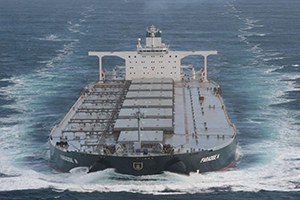
Ships do not have a “handbrake” and, due to their inertia, take a very long time to come to a complete stop from full speed. Exactly how long depends on the specific circumstances: on the ship’s speed and mass (deadweight and cargo), as well as the engine’s power.
According to the guidelines of the International Maritime Organization (IMO), a ship must come to a stop from full speed within 15 ship lengths; in exceptional cases, 20 ship lengths are also permitted. A 350-meter-long large container ship must therefore come to a stop within a little over 5 kilometers.
There are formulas that can be used to roughly calculate the stopping behavior for different types of ships. On every ship, the stopping times and distances must be available on the bridge so that every master knows the braking behavior of their ship.
But how do you stop a ship if there are no brakes? Normally, the engine is set to “full astern.” However, depending on the engine’s response time and the flow conditions at the rudder, it may be more effective for some ships to stop the engine and then simply let the ship coast to a stop.
Of course, all of this raises the question: Don’t the long stopping distances of large ships pose a safety hazard? Fortunately, this is generally not the case: Thanks to radar, the Automatic Identification System (AIS), and maritime traffic monitoring—especially near the coast—every master has ample opportunity to avoid collisions with other ships or obstacles by taking timely evasive action.
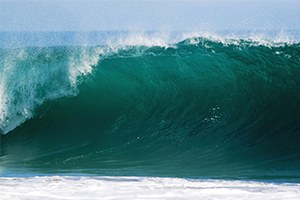
For a long time, it was believed that tales of enormous solitary waves appearing out of nowhere were merely the product of sailors’ imaginations: stories of crashing giant waves simply captivate listeners.
About forty years ago, scientific proof that such waves actually exist was finally obtained for the first time. In 1995, the Norwegian offshore platform “Draupner” recorded a gigantic, nearly 26-meter-high rogue wave in the North Sea.
Today we know: Giant waves—also known as freak waves or rogue waves—are rare but real phenomena. Such waves are often between 20 or even over 30 meters high—significantly higher than the surrounding waves—and do not appear to curve harmoniously, but rather rise almost as steeply as a wall. This, combined with the fact that they appear out of nowhere, makes freak waves one of the most dangerous natural phenomena at sea. They can severely damage ships or even cause them to sink.
Ocean mapping is becoming increasingly detailed and precise, and there are research projects underway to use the collected data and AI analysis to predict where such a wave might form. Even if the forecast is only accurate to a few minutes, it makes a difference for the ship’s crew whether they are completely caught off guard by a wall of water or can prepare for it both mentally and physically.
If you’d like to learn more about this topic, here are a few additional links:
- Final report: "Freak Waves II – Studie zum Auftreten von Extremwellen in der südlichen Nordsee" (study on the occurance of extreme waves in the southern North Sea)
- VDI-Verlag: KI-Tool sagt tödliche Monsterwellen voraus (AI tool predicts fatal freak waves)
- nature.com: Prediction of freak waves from buoy measurements
- University of Copenhagen: AI finds formula on how to predict monster waves
(last updated 06/2026)

It sounds so romantic, but no: Under German law, masters are not permitted to perform marriage ceremonies on board their seagoing vessels—only civil registrars have the authority to do so.
And even registrars may only perform a legally valid wedding ceremony on a ship if the relevant registry office has officially recognized the ship as a wedding venue. The ship must be located within the respective (German) registry office district during the wedding ceremony. Since German territorial waters are only incorporated into municipal areas in exceptional cases, weddings on ships generally take place in ports belonging to the municipality.
Other countries, such as Malta, Bermuda, and the Bahamas, on the other hand, allow masters of ships flying their flags to perform marriages in international waters. For example, couples can get married aboard the “Mein Schiff” fleet of the cruise operator TUI Cruises—though under Maltese law, since the ships sail under the Maltese flag.
Compared to a German wedding, however, there are more formalities involved—at least for German couples. For example, the signatures on the marriage certificate must be notarized, and one or more apostilles (documents certifying authenticity) are required. Anyone who also needs a German marriage certificate or wishes to change their tax bracket later must have their marriage retroactively recorded in the marriage register at the relevant German registry office.
For those who want more details, here are the relevant German legal provisions:
(last updated 06/2026)
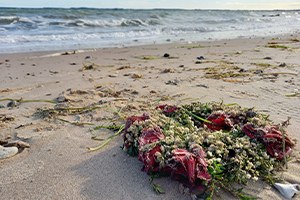
We’ve all seen emotional scenes in movies where loved ones scatter the ashes of their deceased relatives into the sea from a beach or a ship. In reality, this is not permitted just like that.
In Germany, sea burials may only take place in designated sea areas outside the three-mile zone in the North and Baltic Sea. These burial areas, located outside fishing and water sports zones, are designated by the Waterways and Shipping Authorities.
If the urn is to be interred outside German territorial waters (beyond the 12-mile zone), a permit from the Federal Maritime and Hydrographic Agency (BSH) is required, which is typically applied for by a funeral company (see BSH information leaflet (in German only)).
Burial at sea is only permitted with a marine urn that completely dissolves in seawater within three days. To ensure the urn sinks quickly to the bottom and does not float on the water’s surface, it is weighted with gravel, sand, or water.
The coordinates of the burial site, the personal details of the deceased, and the time of the burial are recorded in the logbook of the vessel from which the burial at sea takes place.
(last updated 06/2026)