



How long does it take for a large ship to come to a stop?
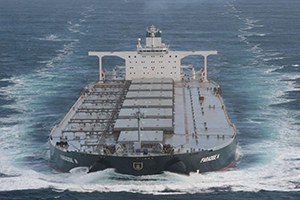
Ships do not have a “handbrake” and, due to their inertia, take a very long time to come to a complete stop from full speed. Exactly how long depends on the specific circumstances: on the ship’s speed and mass (deadweight and cargo), as well as the engine’s power.
According to the guidelines of the International Maritime Organization (IMO), a ship must come to a stop from full speed within 15 ship lengths; in exceptional cases, 20 ship lengths are also permitted. A 350-meter-long large container ship must therefore come to a stop within a little over 5 kilometers.
There are formulas that can be used to roughly calculate the stopping behavior for different types of ships. On every ship, the stopping times and distances must be available on the bridge so that every master knows the braking behavior of their ship.
But how do you stop a ship if there are no brakes? Normally, the engine is set to “full astern.” However, depending on the engine’s response time and the flow conditions at the rudder, it may be more effective for some ships to stop the engine and then simply let the ship coast to a stop.
Of course, all of this raises the question: Don’t the long stopping distances of large ships pose a safety hazard? Fortunately, this is generally not the case: Thanks to radar, the Automatic Identification System (AIS), and maritime traffic monitoring—especially near the coast—every master has ample opportunity to avoid collisions with other ships or obstacles by taking timely evasive action.